


Graphite crucibles are among the most widely used consumables in metal melting and high-temperature processing. Their appeal lies in a rare combination of properties: exceptional thermal conductivity, outstanding resistance to thermal shock, and the ability to withstand extreme temperatures without reacting with most molten non-ferrous metals. However, performance varies dramatically depending on the type of graphite crucible selected and the operating conditions it faces. Understanding these differences is essential for anyone specifying a crucible for foundry work, laboratory research, or industrial melting operations.
What Is a Graphite Crucible?
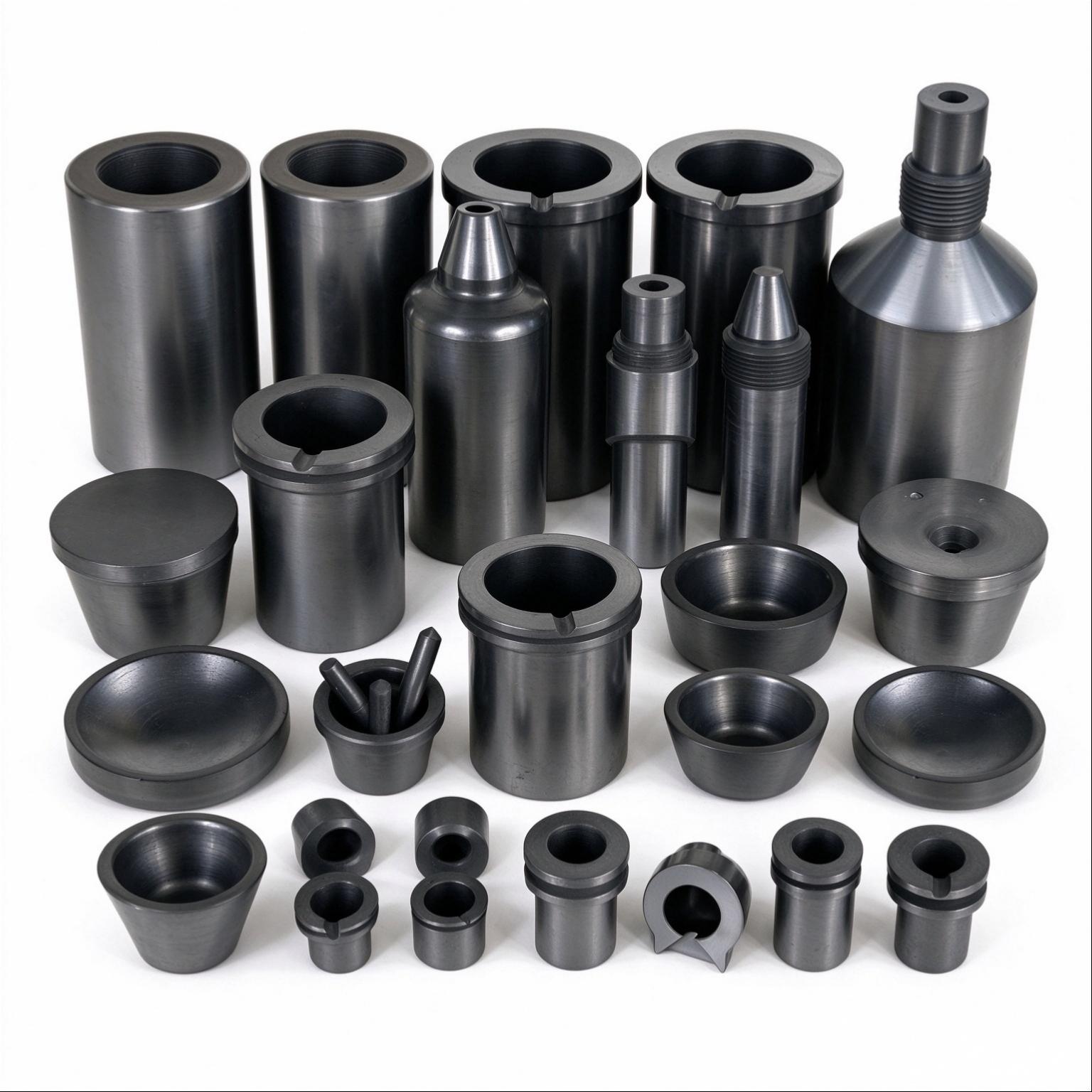
A graphite crucible is a vessel made primarily from graphite, used to hold and melt metals, alloys, and other materials at high temperatures. The category actually encompasses two distinct product families with very different compositions and performance profiles.
Clay-graphite crucibles are composite products. They are manufactured by mixing natural flake graphite with clay binders, silicon carbide, and other refractory materials, then forming and firing the mixture into shape. The graphite content typically ranges from 45% to 55%, with the remainder consisting of clay and other additives that provide structural integrity. These crucibles are the workhorses of general foundry work, offering a cost-effective balance of durability and thermal performance for melting aluminum, brass, bronze, and other non-ferrous metals.
High-purity graphite crucibles, by contrast, are machined from a solid block of high-density, isostatically pressed graphite. They contain no binder phase—the entire crucible is graphite, with ash content often below 1% and in premium grades below 20 ppm. This purity makes them indispensable for melting precious metals, high-purity alloys, and materials where any contamination from the crucible would compromise the final product.
Key Properties and Performance Characteristics
The thermal properties of graphite crucibles are what make them so valuable in high-temperature applications. Graphite conducts heat efficiently, allowing rapid and uniform heating of the charge inside. It also possesses exceptional resistance to thermal shock, meaning it can withstand rapid temperature changes without cracking—a critical advantage in foundry environments where heating cycles are often irregular.
The temperature limits depend heavily on the crucible type and atmosphere. High-purity graphite can withstand temperatures exceeding 3000°C in inert or vacuum atmospheres. Clay-graphite crucibles typically max out around 1600°C, though this is more than adequate for most non-ferrous melting applications. The critical caveat is oxidation: graphite begins to oxidize rapidly in air above approximately 500°C. This means graphite crucibles must be used in inert gas or vacuum environments, or protected by a glaze coating when used in open-air furnaces. In a fuel-fired furnace without protection, a graphite crucible will degrade quickly—potentially lasting only a few melts instead of dozens.
Chemical compatibility is another decisive factor. Graphite crucibles perform excellently with non-ferrous metals such as aluminum, copper, brass, gold, and silver. However, graphite reacts with ferrous metals like iron and steel, causing carbon pickup that contaminates the melt and degrades the crucible. For steel and iron melting, silicon carbide or ceramic crucibles are the appropriate choice.
Choosing the Right Graphite Crucible
Selecting a graphite crucible is fundamentally an exercise in matching the material to the application’s demands. The following framework can guide that decision.
For general non-ferrous foundry work—melting aluminum, brass, or bronze in a fuel-fired furnace—a clay-graphite crucible offers the best balance of cost, durability, and thermal performance. These crucibles are affordable, widely available in standard shapes, and forgiving enough for occasional use. They do require careful preheating to drive out absorbed moisture, which can cause cracking if not addressed.
For precious metals or high-purity applications, a high-purity graphite crucible is the correct specification. The absence of binders and impurities prevents contamination of the melt, and the smooth machined surface minimizes metal adhesion and losses. These crucibles are also preferred for induction furnaces, where the crucible itself is heated directly by the electromagnetic field.
For laboratory and battery research applications, the choice depends on atmosphere. Graphite crucibles are suitable for inert or reducing atmospheres, but must not be used in air at elevated temperatures. Alumina crucibles are preferred where chemical inertness in oxidizing atmospheres is required.
For silicon melting and similar specialized processes, graphite crucibles with engineered features—such as vertical slits that allow electromagnetic forces to act on the melt without wall contact—have been developed to address the reactivity between silicon and graphite.
Practical Handling and Maintenance
The service life of a graphite crucible depends as much on handling as on material quality. The most common cause of premature failure is thermal shock from inadequate preheating. New crucibles should be heated slowly and gradually to remove moisture and allow the material to adjust to thermal expansion. This applies to both clay-graphite and high-purity graphite types, though clay-graphite crucibles are especially moisture-sensitive and require careful drying before first use.
Storage conditions matter as well. Graphite crucibles should be kept in a dry environment; humidity accelerates oxidation and can introduce moisture that leads to cracking during heating. Physical damage from tongs or impacts can also initiate fractures, particularly in high-purity graphite, which is more brittle than clay-bonded composites.
Cleaning between melts helps maintain performance. Residual metal and flux should be removed while the crucible is still warm, using tools that will not gouge the surface. For flux-heavy operations, appropriate crucible coatings can extend life by protecting the graphite from chemical attack.
Summary
Graphite crucibles are not a single product but a family of materials engineered for different melting tasks. Clay-graphite crucibles serve general foundry needs economically and effectively for non-ferrous metals. High-purity graphite crucibles deliver the contamination-free performance required for precious metals and high-value alloys. The decisive selection factors are the metal being melted, the furnace atmosphere, the required purity level, and the operating temperature. When matched correctly to the application and handled with appropriate care, graphite crucibles provide reliable service and excellent thermal performance in the most demanding high-temperature environments.